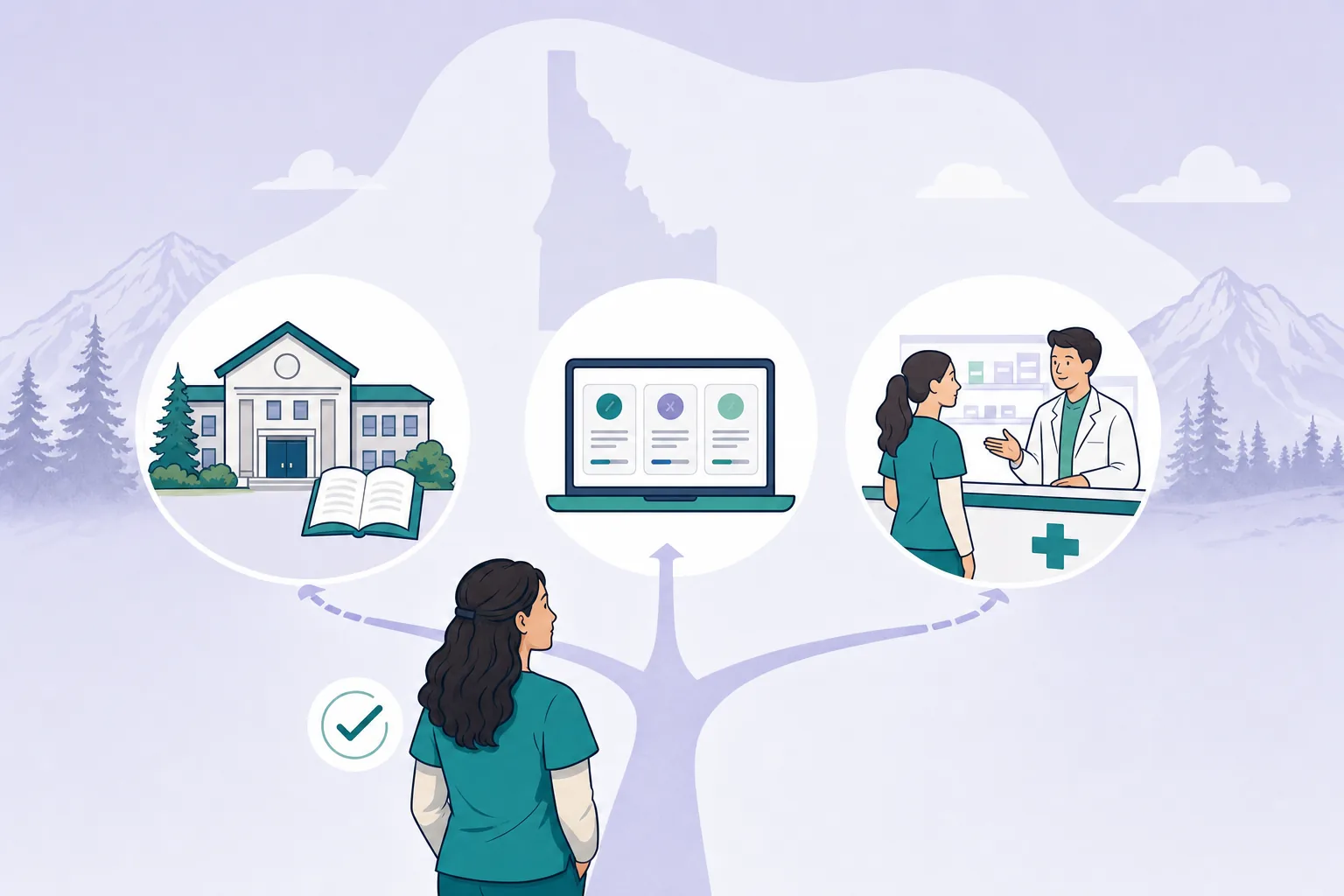
Idaho’s current pharmacy technician checklist does not name a required school. The choices are not the same: you can prepare through a school or workforce course, take an independent PTCB-recognized course, or learn on the job after you’re registered and hired. In a small sample of three Idaho education options, prices ranged from about $440 to $11,900, but those prices cover very different kinds of education and support.
Table of Contents
- Registration, School Certificates, and CPhT Are Different
- Three Idaho Paths at a Glance
- Path 1: An Idaho School or Workforce Option
- Path 2: An Independent PTCB-Recognized Course
- Path 3: Workplace Learning After Idaho Registration
- Which Idaho Path Fits You?
- Before You Enroll: 7 Questions
- Where to Check Each Step
- Frequently Asked Questions
Registration, School Certificates, and CPhT Are Different
Idaho registration is what gives you permission to work as a pharmacy technician in the state. The Idaho State Board of Pharmacy and the Division of Occupational and Professional Licenses (DOPL) issue it. A school can award a certificate or degree, but it can’t register you with Idaho. Hiring and workplace instruction are up to each employer.
National certification comes from PTCB, not from Idaho or a school. PTCB stands for Pharmacy Technician Certification Board. It recognizes certain courses, runs its national exam—the PTCE—and awards the CPhT designation to eligible candidates who pass. CPhT is short for Certified Pharmacy Technician.
Some schools and courses also advertise ASHP/ACPE accreditation. That designation applies to the education offering; it isn’t the same as Idaho registration or PTCB recognition. You may complete a course, earn a school certificate, become registered in Idaho, and earn CPhT at different points in your career.
Idaho’s current pharmacy technician page lists a government-issued photo ID and fingerprint steps. Its checklist does not name a required school, degree, or national credential. So you apply for Idaho registration separately and choose the kind of education or workplace learning that fits you.
Three Idaho Paths at a Glance
Here is the simplest way to think about the three choices.
| Option | What you get first | Cost example | Hands-on learning | What to know |
|---|---|---|---|---|
| School or workforce option | A completion certificate or academic award, depending on the school | About $440 to $11,900 in a dated sample of three Idaho education options | May include labs, simulation, a practicum, or help finding pharmacy experience | Schools differ widely in length, services, and what the price includes |
| Independent PTCB-recognized course | A completed course that PTCB accepts toward CPhT eligibility; not a college award | Pharmacy Tech Scholar℠’s core course is $249; the PTCB fee is separate | No campus lab or school-arranged externship | Best suited to a self-directed learner who can arrange practical experience separately |
| Workplace learning | Instruction and experience in the pharmacy that hires you | You may avoid school tuition, but state, exam, travel, and study costs can remain | Yes, although the depth of instruction depends on the pharmacy | You need issued Idaho registration and a pharmacy willing to hire a beginner |
Bottom line: A lower price doesn’t automatically mean a better fit. A school may cost more because it includes an academic award, scheduled teaching, labs, or help with practical experience. A focused online course offers less of that structure. Learning at work can provide real experience, but only if a pharmacy is ready to hire and teach you.
Path 1: An Idaho School or Workforce Option
A school or workforce option may be a good fit if you want a set schedule, regular instructor contact, and help building practical skills. Depending on the school, you might receive:
- A provider-issued completion certificate or an academic certificate
- Scheduled classes and regular instructor access
- Pharmacy labs, simulation, or supervised skills practice
- A practicum, externship, or help arranging pharmacy experience
- College credit, advising, tutoring, or career services
- Exam preparation or an included exam fee
Not every school includes all of these features. A short, noncredit workforce course is very different from a one-year college certificate. When you compare prices, look at the time commitment, the award you receive, the hands-on component, and any costs that sit outside tuition.
What Idaho education can cost
A small sample of three Idaho public-education options ranged from $439 to an estimated $11,857.50 when checked July 27, 2026. The options were not directly comparable. The sample stretched from a short online workforce course with a required textbook purchased separately to a one-year academic certificate estimate that included tuition, fees, books, and supplies. Another option bundled materials, exam preparation, testing fees, and help arranging pharmacy experience.
Rounded, that is about $440 to $11,900. It is not an Idaho average or a complete market range, and it should not be used as a prediction of what you will pay. Ask each provider for a written total that includes tuition, books, supplies, practical-experience costs, exam fees, and any other required charges. Your own total can also change with travel, living expenses, time away from work, financial aid, or a later exam retake.
The IdahoWorks training search is a useful place to find options. Once you find one, read the provider’s own page and ask for the full price in writing. If accreditation matters to you, look up the exact offering in the ASHP/ACPE technician directory.
Remember that a school certificate shows you completed that school’s course of study. You still apply separately for Idaho registration, and you still have to follow PTCB’s steps if you want CPhT.
Path 2: An Independent PTCB-Recognized Course
An independent PTCB-recognized course focuses on the coursework that can count toward PTCB’s education option. It does not come with the college award, campus services, or built-in practical experience that some schools offer. PTCB recognition also isn’t the same as ASHP/ACPE accreditation or Idaho registration.
Pharmacy Tech Scholar℠’s course is one example. Pharmacy Tech Scholar℠ publishes this article and sells the course, so you should weigh it alongside other options with that relationship in mind.
The core course is listed at $249 and includes 90 modules, a six-book digital library, more than 3,000 exam questions, optional live classes, and learner support. When checked July 27, 2026, PTCB’s recognized-course directory listed 120-Hours to CPhT by Pharmacy Tech Scholar℠ as an online or distance-learning option.
What you won’t receive is just as important: the course does not award college credit, provide a campus lab or school-arranged externship, issue Idaho registration, give you an exam result, or award national certification.
If you pursue CPhT, PTCB’s current CPhT requirements say you must complete recognized education or at least 500 hours of equivalent pharmacy technician work experience, meet the other listed conditions, and pass its exam. The current application-and-exam fee is $129. Added to the $249 course, that is $378 before Idaho registration costs, travel, or optional purchases.
This option may fit if you:
- Learn well in a self-paced online format
- Mainly need education that PTCB recognizes
- Do not need a college credential or campus services
- Have a separate plan for hands-on experience
- Are comfortable handling Idaho registration, the PTCB application, the exam, and your job search separately
If you want a college award, in-person practice, or help arranging pharmacy experience, the lower course price shouldn’t decide the question by itself.
Path 3: Workplace Learning After Idaho Registration
Learning in a pharmacy can be appealing because you build skills where the work actually happens. The difficult part is getting started: unlike a course you can simply enroll in, this option depends on Idaho issuing your registration and a pharmacy choosing to hire a beginner.
The order matters:
- Apply for Idaho registration and wait until it is issued. Sending the application is not the same as being registered.
- Look for a pharmacy willing to hire someone new. Each pharmacy decides whether it has an opening and what it wants from applicants.
- Ask how the pharmacy teaches beginners. Workplace instruction can build practical skills, but it may not follow the PTCE content outline.
- Plan separately for CPhT if that is your goal. PTCB’s experience option calls for at least 500 hours of equivalent pharmacy technician work experience by the time you apply, along with its other conditions and a passing PTCE result.
This choice may let you avoid school tuition, but it can be harder to arrange. Beginner openings, schedules, teaching, exam support, and reimbursement differ from one pharmacy to another. A job is not automatically a formal apprenticeship, and not every pharmacy-related hour will necessarily satisfy PTCB.
Before you accept a position, ask who will train you, which duties you will perform, how your hours are recorded, and whether the company helps with education or exam costs.
For more help with the state application, see the Idaho Pharmacy Technician License Requirements guide and DOPL’s application pages.
Which Idaho Path Fits You?
Choose a school or workforce option if you want more structure
This is the strongest fit if you want scheduled classes, regular instructor contact, an academic award, or help getting practical experience. The extra cost and time can make sense when you will use those services.
Choose an independent course if you learn well on your own
A PTCB-recognized online course may fit if you mainly need the education option for PTCB and don’t need a college award, campus lab, or school-arranged placement. Leave room in your budget for the separate PTCB and Idaho steps.
Look for workplace learning if you are ready to apply for jobs
This choice can work if Idaho has issued your registration and a pharmacy is willing to hire and teach you. Ask how beginner instruction works and whether the duties fit your longer-term goal. Don’t count on an opening, exam payment, or sponsorship until a pharmacy puts the offer in writing.
You can also combine options. For example, you might work in a pharmacy while taking a recognized online course for more organized study. A school graduate will still need to learn the systems used by a particular pharmacy. Combining options can fill gaps, but it can also add time or cost.
Before You Enroll: 7 Questions
Use the same questions with every provider:
- What will I have when I finish? A completion document, an academic award, PTCB-recognized education, practical experience, or some combination?
- What is the full price? Include tuition, fees, books, software, supplies, screenings, travel, Idaho charges, the PTCB fee, and optional extras.
- Will I get hands-on practice? Ask whether the option includes a lab, simulation, practicum, externship, or help arranging experience.
- How does this fit with PTCB? Look up the exact course in PTCB’s directory or ask how workplace hours will be documented.
- What help is available when I get stuck? Ask about instructor access, tutoring, live classes, and technical support.
- What if I can’t complete the next step? Read the refund and withdrawal terms and ask what happens if a class, practical site, or beginner job falls through.
- What will I still need to do afterward? You may still need Idaho registration, a separate PTCB application and exam, workplace experience, or a job search.
Get the answers in writing. The best value is the option that gives you the support you will actually use—not automatically the broadest package or the lowest advertised price.
Where to Check Each Step
These are the pages worth bookmarking:
- For registration, read the Idaho DOPL pharmacy technician page and use the Idaho DOPL application and renewal page to apply. DOPL is the official state agency handling the application.
- For school and workforce options, start with the IdahoWorks training search, then read the provider’s own current page.
- For the PTCB education option, search the exact course in the PTCB directory.
- For accreditation, use the ASHP/ACPE directory.
- Finally, ask the provider for the complete price, included services, practical-experience plan, and cancellation terms in writing.
Frequently Asked Questions
Does Idaho require pharmacy technician school?
Idaho DOPL’s current technician checklist does not name a required school, degree, or national credential. You still need to complete the registration steps, and a pharmacy may ask for additional education or experience when it hires.
Is a school certificate the same as CPhT certification?
No. A school certificate shows that you completed that school’s course of study. CPhT is a national credential that PTCB awards after an eligible candidate passes the PTCE. Idaho registration is separate from both.
Is PTCB recognition the same as ASHP/ACPE accreditation?
No. PTCB recognition means the course can count toward PTCB’s education option. ASHP/ACPE accreditation is a separate designation for qualifying schools and courses. Neither one registers you in Idaho or makes you a CPhT.
Can I complete Idaho pharmacy technician education online?
Yes. Current Idaho provider pages and PTCB’s directory include online options. Ask whether the course includes live help, hands-on practice, a school award, exam fees, or help finding pharmacy experience. The word online tells you how the course is delivered, not everything you receive.
Can I start with workplace learning instead of a course?
Possibly. First complete Idaho’s registration steps and find a pharmacy willing to hire and train a beginner. If you later use PTCB’s experience option, PTCB calls for at least 500 hours of equivalent pharmacy technician experience plus its other conditions.
How much do pharmacy technician programs cost in Idaho?
A small sample of three Idaho education options checked July 27, 2026 ranged from $439 to an estimated $11,857.50. That is not a statewide average or a complete range, and the options include very different services. Pharmacy Tech Scholar℠’s independent core course is $249, but it does not include the academic award, campus lab, or arranged practical experience that a school may offer.
There isn’t one best choice for everyone. Decide whether you most need school structure, a focused online course, or experience tied to a job. Then make sure you know what the option includes, what it leaves for later, and what you will need to do next in Idaho.