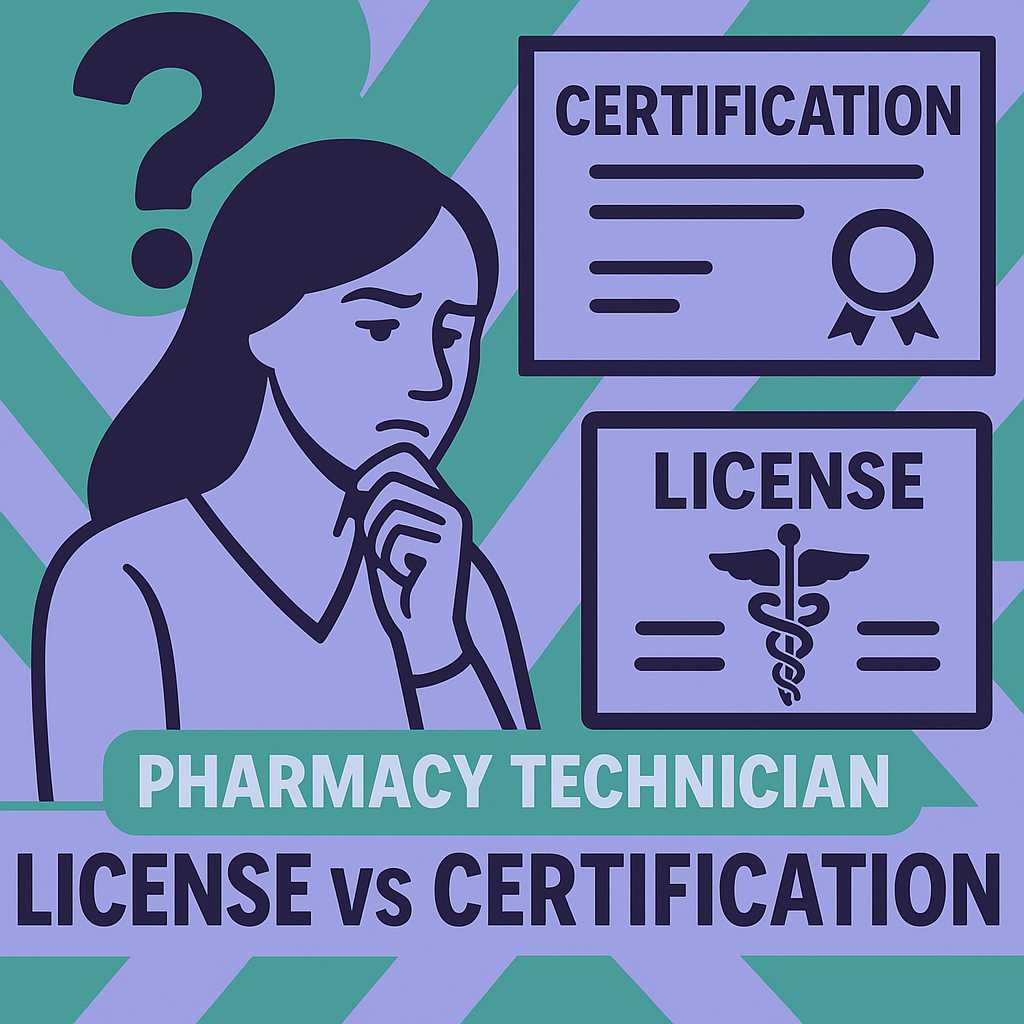
Here’s the difference: a pharmacy technician license or registration is your state’s permission to work as a pharmacy technician. CPhT certification is a national qualification earned by meeting a certification organization’s rules and passing its exam. Neither replaces the other.
Most states regulate pharmacy technicians in some way. The official status may be called a license, registration, permit, or trainee registration. Begin with the pharmacy technician rules where you plan to work. Then find out whether the licensing agency or employer also asks for CPhT. The U.S. Bureau of Labor Statistics provides this broad national context.
Table of Contents
- License or registration vs CPhT at a glance
- What a pharmacy technician license or registration means
- What CPhT means
- Which one do you need?
- How to find the rules where you plan to work
- Common mistakes to avoid
- Pharmacy technician license vs certification FAQ
- Your next step
License or registration vs CPhT at a glance
The simplest way to separate the two is to ask what each one does for you.
| Question | License, registration, permit, or trainee status | CPhT certification |
|---|---|---|
| Who issues it? | A board of pharmacy or another government licensing agency | A national organization such as PTCB or NHA |
| What does it mean? | You completed the steps for the technician or trainee category named on your application | You met the organization’s standards and passed its exam |
| Does it let me work? | It is the public record that gives you permission to work in the named category | No. CPhT does not replace a license, registration, permit, or trainee status |
| Do I need it? | Most states regulate pharmacy technicians; the name and category vary | The licensing page and job listing tell you whether CPhT is needed |
| What happens if I move? | Your old license or registration does not automatically satisfy a new location’s rules | An active CPhT stays with you, but it does not replace a new application |
| Where should I start? | The pharmacy technician page for the job location | The PTCB or NHA page after you know CPhT is part of your path |
Takeaway: first find out what you must hold to work as a pharmacy technician. Then find out whether the job also requires or prefers CPhT.
What a pharmacy technician license or registration means
Think of a license or registration as your active pharmacy technician record with the licensing agency. It shows that you completed the steps for the category under which you will work. That category might be pharmacy technician, registered pharmacy technician, licensed pharmacy technician, technician trainee, or technician-in-training.
The steps are not the same everywhere. An application may ask for training, a background check, an exam or CPhT, a fee, a minimum age, or some combination of those items. The BLS describes these broad possibilities; the current application tells you which ones apply.
A license or registration does not mean that you hold CPhT. It only describes the government-issued record shown on the application.
Why the wording can be confusing
People often use “license” as a general term, even when the application says registration or permit. A job listing may also say “licensed pharmacy technician” while the licensing page says “registered pharmacy technician.”
Those wording differences do not always mean two separate items. Match the job listing to the category on the pharmacy technician application. If the terms still do not line up, ask the hiring team which one it expects.
If you are trying to sort out the initials, RPhT vs CPhT explains registered-versus-certified terminology in more detail.
What CPhT means
CPhT stands for Certified Pharmacy Technician. It shows that you met a national organization’s standards and passed its pharmacy technician exam. It does not mean that a government licensing agency has approved you to work.
Two options you may encounter are:
- The Pharmacy Technician Certification Board (PTCB) awards CPhT after a candidate meets its rules and passes the PTCE.
- The National Healthcareer Association (NHA) offers CPhT through the ExCPT.
The organization and exam names are easy to mix up. PTCB vs PTCE explains that distinction.
A licensing agency or employer may ask for CPhT, and a workplace may prefer it even when it is not mandatory. It still does not replace an active license or registration.
Which one do you need?
Read the pharmacy technician rules for the job location before choosing an exam. Reading those rules first does not necessarily mean you must submit a license or registration application before earning CPhT. It simply tells you which steps apply and in what order.
You are new to pharmacy technician work
Find the pharmacy technician licensing page and look for the category that matches a new applicant. Common paths include registration before work, a trainee option, or CPhT before moving into a full technician category. Once you know the path, compare it with current job listings.
If you want to know whether you can begin before earning CPhT, read Can You Be a Pharmacy Tech Without Certification?.
A job listing requires or prefers CPhT
If CPhT is mandatory, you must satisfy that job condition in addition to any license or registration rules. If it is preferred, you may still be able to apply without it. When the listing does not name an accepted organization, ask the hiring team before choosing an exam.
Wait until your CPhT is active before adding the initials after your name.
You already hold CPhT
You have already handled the national exam. You still need to complete any license, registration, permit, or trainee steps where you plan to work.
You are moving
Begin with the pharmacy technician page for your new location. Keeping CPhT active may satisfy the national-certification piece, but it does not automatically transfer your old license or registration.
Use the pharmacy technician license transfer guide for a moving checklist.
How to find the rules where you plan to work
Use the State Certification Impact Lookup Tool below to see how CPhT may fit where you plan to work. Then follow the linked guide or licensing page for the current application details.
For a broader starting point, open Pharmacy Technician License Requirements by State. You can also use the National Association of Boards of Pharmacy directory to find the board or licensing agency.
The state board of pharmacy or other official agency gives the final answer for your state.
On the licensing page, look for four answers:
- What is the license, registration, permit, or trainee category called?
- Must you obtain it before starting work, or is there a trainee option?
- Is CPhT part of the licensing rules?
- Does the job listing add training, experience, or another condition?
Those answers will tell you whether your next step is an application, an exam, a trainee position, or a conversation with the employer.
Common mistakes to avoid
- Calling PTCB a license. PTCB awards CPhT; it does not issue pharmacy technician licenses.
- Treating a training certificate as CPhT. A school or employer may give you a course-completion certificate. CPhT comes from a national organization after you meet its rules and pass its exam.
- Assuming every state uses the word “license.” The official term may be registration, permit, trainee, or technician-in-training.
- Reading only the job listing. A listing tells you what the employer wants, but the licensing page tells you what you must hold before working.
- Assuming your old registration moves with you. Read the rules for the new location before relying on transfer or reciprocity.
- Using initials before they are active. Add CPhT or a licensing title to your name only after you actually hold it.
Pharmacy technician license vs certification FAQ
Is CPhT the same as a pharmacy technician license?
No. CPhT is a national certification. A pharmacy technician license, registration, permit, or trainee status comes from a government licensing agency.
Do most states require pharmacy technicians to be licensed or registered?
Most states regulate pharmacy technicians, but the official category is not always called a license. You may see registration, permit, trainee, technician-in-training, or another title. Use the pharmacy technician page for the place where you plan to work.
Is pharmacy technician registration the same as a license?
Both come from a government licensing agency, but the terms are not interchangeable everywhere. Use the name and category shown on the application.
Is PTCB a pharmacy technician license?
No. PTCB is the Pharmacy Technician Certification Board. It awards CPhT to candidates who meet its rules and pass the PTCE; it does not issue licenses or registrations.
Do I need both state registration and CPhT?
You may. Some paths call for registration or licensure without CPhT, some include a trainee option, and others call for both. A workplace can also make CPhT mandatory or preferred. Read the licensing rules first, then compare them with the job listing.
Which comes first: CPhT or state registration?
The order depends on the licensing path. Some people earn CPhT before applying for full registration, while others begin under a trainee option. Reading the pharmacy technician rules first will show you which order applies.
What happens to CPhT if I move?
Your CPhT remains active with the organization that awarded it as long as you maintain it. Your old license or registration does not automatically satisfy the rules in a new location.
Your next step
Begin with the pharmacy technician page for the place where you plan to work. Find the exact license, registration, permit, or trainee category, note whether CPhT is part of it, and compare that information with the job listing. If CPhT is needed, use the current PTCB or NHA candidate page before choosing an exam or training program.
Sources for this article
- U.S. Bureau of Labor Statistics — Pharmacy Technicians
- PTCB — Certified Pharmacy Technician (CPhT)
- NHA — Certified Pharmacy Technician (CPhT)
- NABP — Boards of Pharmacy
These sources explain the broad national distinction between licensing and CPhT. For application steps, use the current pharmacy technician page for the place where you plan to work.