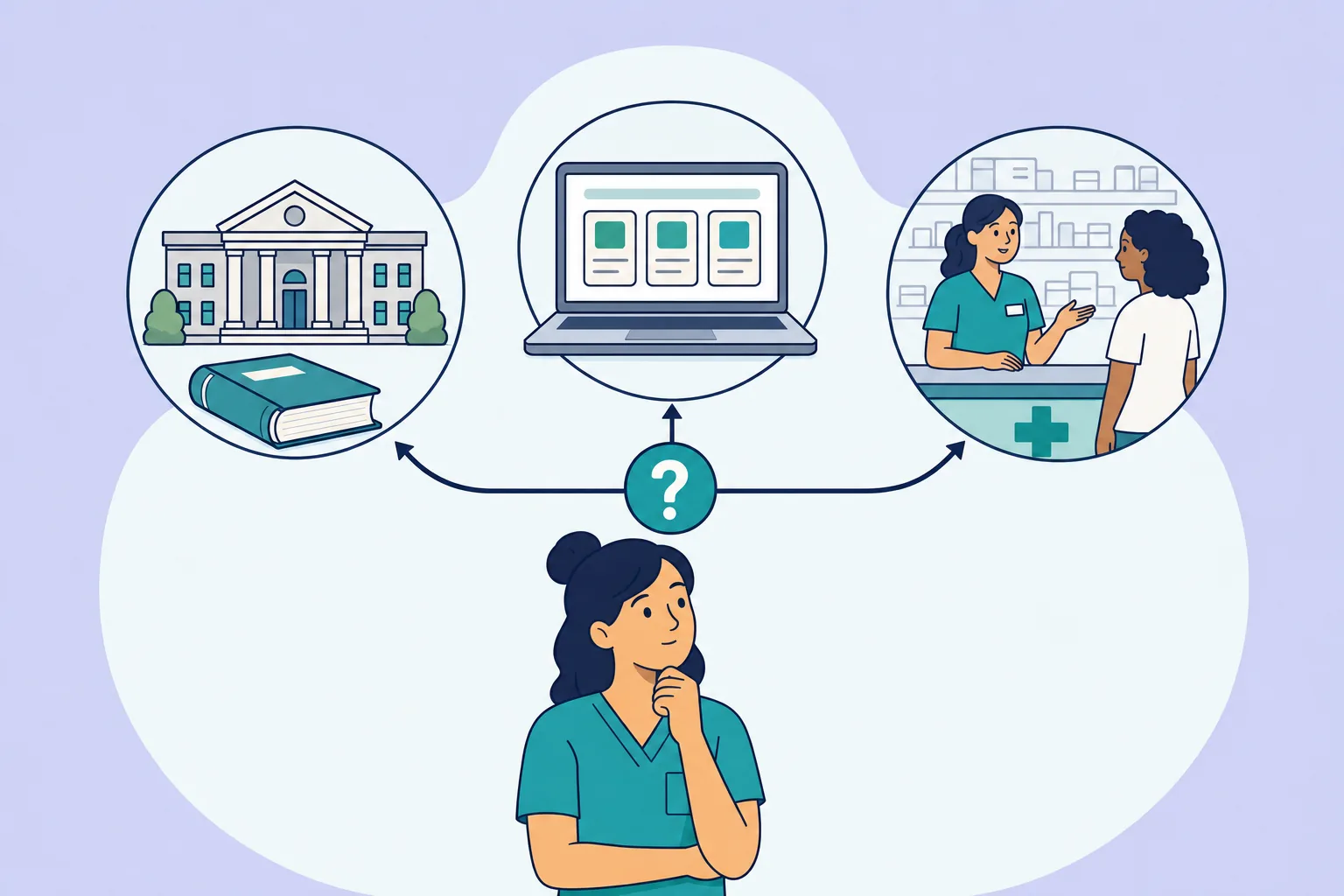
If you’re comparing pharmacy technician programs in Missouri, you have three practical ways to prepare: attend a school or college, take an independent online course, or learn through a pharmacy employer. Missouri doesn’t make one course or a national exam part of ordinary technician registration. The main differences are structure, hands-on experience, academic credit, and price.
Here’s what the main labels mean. The Missouri Board of Pharmacy issues pharmacy technician registration, which is Missouri’s permission to work in this role. Missouri calls this status registration; not a technician license or permit. A school or course provider controls its own curriculum and awards any completion record, school certificate, diploma, degree, or college credit. A pharmacy employer decides whom to hire and how workplace instruction, duties, scheduling, and pay will work.
The Pharmacy Technician Certification Board (PTCB) controls a separate national path. It recognizes education offerings for one eligibility option and administers the Pharmacy Technician Certification Exam (PTCE). CPhT means Certified Pharmacy Technician; PTCB grants that designation after a candidate meets its requirements and passes the exam. The ASHP/ACPE collaboration separately grants programmatic accreditation to qualifying technician education. A school award, PTCB recognition, accreditation, the PTCE, CPhT, and Missouri registration are different things.
For school-based planning, a three-school U.S. sample reviewed in July 2026 ranged from about $2,100 to $22,400 in published totals. That isn’t a Missouri tuition average. The sample covered three very different school models, and a Missouri option may cost less or more.
One more Missouri term matters if you hope to train at work. A pending applicant is someone who has submitted the required registration application and fee but hasn’t received registration yet. Current Missouri instructions also require proof of fingerprinting before technician work begins. The applicant keeps a copy of the application at the pharmacy and must stop working if registration is refused. Our Missouri pharmacy technician requirements guide covers the application details.
Table of Contents
- Compare the three ways to prepare in Missouri
- What Missouri requires before you work
- School and college options: more structure, a wider price spread
- Independent online courses: flexible and usually narrower
- Employer-based learning: direct experience, but job-dependent
- Which preparation path fits you best?
- Eight questions to ask before you enroll
- A practical order for your next steps
- Frequently asked questions
- Choose the path that gives you what you need
Compare the three ways to prepare in Missouri
These options teach some of the same subject matter, but they don’t provide the same experience or lead to the same first result.
| Option | What you get first | Hands-on experience | Cost picture | Often a good fit for |
|---|---|---|---|---|
| School or college | A completion record and, depending on the offering, credit, a certificate, diploma, or degree | May include labs, simulation, an internship, or a clinical rotation | A three-school U.S. sample ranged from about $2,100 to $22,400; packages varied widely | Learners who want a set schedule, instructor access, school services, or an academic award |
| Independent online course | A course-completion record | Usually arranged separately | Course-specific; add anything not included, such as the exam, Missouri application expenses, supplies, or workplace experience | Self-directed learners who want flexible, focused study and don’t need a college award |
| Employer-based learning | Supervised workplace instruction and experience | Built into the job | Employer-specific; don’t assume study time, exams, or Missouri application expenses are covered | Beginners who have a pharmacy willing to hire and teach them |
Bottom line: Choose by the first result you want, the amount of guidance and hands-on experience you need, and the complete price.
Missouri registration remains a separate step whichever path you choose. If CPhT is part of your plan, confirm how your education or work experience fits PTCB’s current eligibility rules rather than assuming any course or job automatically qualifies.
What Missouri requires before you work
The Board’s current practice guide says there is no general minimum education or credential requirement for ordinary pharmacy technician registration. In other words, Missouri doesn’t make every beginner finish formal schooling or earn CPhT before applying.
That flexibility doesn’t remove the registration process. Under Missouri Revised Statutes § 338.013, a pending applicant may perform technician duties after the required application and fee have been submitted. The current technician application instructions also require proof of fingerprinting before pending-applicant work begins. Keep the application copy at the pharmacy and stop working if registration is refused.
A pharmacy may set hiring standards above Missouri’s minimum. Certain specialized activities also come with added instruction, competency, experience, or credential rules, so don’t assume the general entry rule covers every possible duty.
For the final local answer on registration or allowed duties, use Missouri’s official state board pages.
School and college options: more structure, a wider price spread
School-based education can make sense if you learn best with deadlines, want regular access to an instructor, hope to earn college credit, or prefer help arranging practical experience. Depending on the offering, you might see scheduled classes, online coursework, labs, internships, clinical rotations, tutoring, or career services. None of those features is automatic, so compare the exact offering (not just the school name).
How much should you budget for a school-based option?
To give you a useful sense of scale without turning this page into a school directory, we reviewed published totals from three different U.S. school models: a technical certificate, a community-college diploma, and a private-college diploma. The totals were $2,105, $7,757.50, and $22,428. Rounded, that’s about $2,100 to $22,400.
This is a planning range, not a Missouri average or a promise of what you’ll pay. The three options differed in length, delivery, academic award, books and fees, and the amount of practical experience included. A Missouri school can fall below or above the sample.
Ask each school for an itemized total that answers these questions:
- What are the tuition and mandatory fees?
- Are books, software, supplies, uniforms, and equipment included?
- Will you pay separately for screening, health requirements, travel, or a clinical placement?
- Does the price include the PTCE or another national exam?
- Are Missouri application and fingerprinting costs separate?
- What deposits are nonrefundable, and what is the withdrawal or refund deadline?
The lowest advertised price isn’t necessarily the least expensive path once you add books, travel, exams, and practical experience. By the same token, a higher school total may include college credit, facilities, instructor time, or an arranged placement that a narrower course doesn’t provide.
Find out what the school actually awards
The word certificate causes a lot of confusion. A school might award an academic certificate or simply provide a certificate of completion. Neither one is PTCB’s CPhT credential, and neither replaces Missouri registration.
If an offering says it is PTCB-recognized, look for its exact title in PTCB’s recognized education directory. If it says it is accredited, ask what kind of accreditation it means. You can check a claim of ASHP/ACPE technician-education accreditation in the ASHP/ACPE directory. Institutional accreditation and programmatic accreditation aren’t interchangeable.
Independent online courses: flexible and usually narrower
An independent online course may fit if you want to study around work or family responsibilities and don’t need a college credential. The tradeoff is that you may have to arrange hands-on experience, the Missouri registration process, the national exam, and job applications yourself.
If CPhT is your goal, PTCB currently accepts either PTCB-recognized education or at least 500 hours of equivalent pharmacy technician work experience as its two eligibility paths, along with its other requirements. PTCB decides whether a particular course or work history qualifies. Completing a recognized course doesn’t mean you’ve already passed the PTCE or earned CPhT.
Disclosure: Pharmacy Tech Scholar℠ publishes this article and sells the independent course described here. Its 120-Hours to CPhT course appeared in PTCB’s directory for CPhT as an online/distance-learning offering when this article was reviewed. As of August 23, 2026, the Core Course costs $249 and includes 120 hours of coursework, digital books, practice questions, learner support, optional live review, and six months of access.
That $249 price covers independent online education and study support. It doesn’t include college credit, an academic award, a campus lab, a school-arranged externship, Missouri registration, a PTCE result, CPhT, or a job. That’s why it isn’t an apples-to-apples price comparison with a college package.
For any online option, check the exact course title, access period, instructor support, refund policy, exam-fee inclusion, and current PTCB status before enrolling.
Employer-based learning: direct experience, but job-dependent
Missouri’s rules leave room for a beginner to learn in a pharmacy instead of completing school first. This can be an appealing path because you gain experience in the setting where you’ll actually work. The catch is that you need a pharmacy willing to hire and train a beginner.
Follow Missouri’s application and fingerprinting sequence before performing technician duties as a pending applicant. Then ask the employer:
- Who trains new technicians, and how is progress documented?
- Which duties can a beginner perform, and when?
- Is study time paid, and is exam preparation or reimbursement available?
- Does the pharmacy expect CPhT by a certain date?
- Are any specialized duties part of the job, with extra Missouri instruction or credential requirements?
Work experience can help with PTCB eligibility, but not every shift or task automatically counts. Review your experience against PTCB’s current CPhT eligibility page before relying on the 500-hour route.
Which preparation path fits you best?
Choose a school or college if you want a fixed schedule, direct instructor contact, an academic credential, campus support, or practical experience arranged by the school. Get the complete price and exact award in writing before you commit.
Choose an independent online course if flexibility matters most and you’re comfortable arranging Missouri registration, the exam, workplace experience, and job applications separately. Compare course support and access limits, not just the sticker price.
Consider employer-based learning if a pharmacy has a clear plan for hiring and teaching beginners. Make sure you understand the Missouri pending-applicant sequence and ask how the employer documents instruction and work hours.
You can combine paths, too. For example, you might use an online course for structured exam study while learning pharmacy systems through an employer. A school may combine classroom learning with an internship. The important question is which pieces are included and which ones are still yours to arrange.
Eight questions to ask before you enroll
Offer names can sound nearly identical even when the actual packages are very different. Get clear answers to these eight questions before enrolling:
- What will I receive when I finish? A completion record, school certificate, diploma, degree, college credit, or something else?
- What is the full price? Include required fees, books, supplies, technology, uniforms, screening, travel, exams, and Missouri application expenses.
- Is hands-on experience included? If so, is it a lab, internship, externship, clinical rotation, or paid job—and who arranges it?
- Does the exact offering currently appear in PTCB’s directory? Don’t rely on a similar title.
- Is any accreditation claim institutional or specific to the technician curriculum? Ask which organization grants it.
- Which national exam does the curriculum prepare me for, and is the exam fee included? Preparation isn’t the same as eligibility or passing.
- How long will I have access, and what happens if I withdraw or need more time? Check extension and refund terms.
- What will I still need to do afterward? List Missouri registration, practical experience, the exam, CPhT, and employer requirements separately.
Put the answers side by side. A more expensive school option may be worthwhile if it includes an academic award and arranged experience you value. A lower-cost course may be the better fit if you need focused study and already have a plan for the other steps.
A practical order for your next steps
- Decide whether you want school structure, online flexibility, or employer-led learning.
- Ask your preferred provider or employer for the exact outcome, full price, practical-experience plan, and refund or withdrawal terms.
- If CPhT is part of your goal, compare the exact education or experience path with PTCB’s current eligibility page and directory.
- Before technician work begins, use Missouri’s technician resources and current application instructions for the local sequence.
For a fuller explanation of the terminology, see our license-versus-certification guide. If you’re comparing accreditation claims, our accredited pharmacy technician programs guide explains the difference between institutional and programmatic accreditation.
Frequently asked questions
How much do pharmacy technician programs cost in Missouri?
Missouri schools don’t publish prices in one directly comparable format, so there isn’t a responsible statewide average. For planning, a three-school U.S. sample reviewed in July 2026 ranged from about $2,100 to $22,400 in published totals. A Missouri option may cost less or more. Ask for an itemized total that includes tuition, fees, books, supplies, practical experience, exams, Missouri application expenses, and travel.
Does Missouri require pharmacy technician school?
No. Missouri doesn’t require one specific school or course for ordinary pharmacy technician registration. A pharmacy may still prefer or require education or CPhT, and certain specialized activities have additional rules.
Do I need the PTCE or CPhT to register in Missouri?
Not for ordinary registration under Missouri’s general rule. PTCB controls the PTCE and CPhT credential, while the Missouri Board controls registration. Employers may set CPhT expectations above Missouri’s baseline.
Can I train on the job as a Missouri pharmacy technician?
Yes, if a pharmacy is willing to hire and teach you and you follow Missouri’s pending-applicant requirements before performing technician duties. Workplace learning doesn’t automatically satisfy every PTCB eligibility condition, so check your experience against PTCB’s current rules.
Is a school certificate the same as CPhT?
No. A school or course provider gives you its own completion document or academic award. PTCB awards CPhT after you meet its eligibility rules and pass the PTCE. The Missouri Board separately issues state registration.
Is PTCB recognition the same as accreditation?
No. PTCB recognition applies to one of PTCB’s education eligibility paths. ASHP/ACPE programmatic accreditation is a separate status based on a different review process. Neither one is Missouri registration, a passing exam result, or CPhT.
Choose the path that gives you what you need
There isn’t one best choice for every future Missouri pharmacy technician. A school may be worth the higher price if you want an academic award, instructor access, or arranged experience. An online course may make more sense if you want focused, flexible study. Employer-based learning may fit when a pharmacy is ready to teach you and the Missouri sequence is clear.
Start with the outcome you want, compare the full price and missing pieces, and then follow the Missouri and PTCB steps that apply to your plan. If self-paced education fits that plan, you can review the Pharmacy Tech Scholar℠ course as one disclosed independent option.
Sources
- Missouri Revised Statutes § 338.013
- Missouri pharmacy technician guide
- Missouri pharmacy technician application and instructions
- Missouri pharmacy practice guide
- PTCB Certified Pharmacy Technician eligibility
- PTCB-recognized education directory
Missouri requirements, PTCB pages, and course details were checked August 23, 2026. The three-school cost sample was reviewed in July 2026. Requirements and prices can change.