If you’re comparing pharmacy technician programs in Michigan, you have three practical ways to prepare: school or college study, independent online education recognized by the Pharmacy Technician Certification Board (PTCB), or a specific workplace offering approved by the Michigan Board of Pharmacy. The difference is what each gives you first; none automatically gives you national certification or a Michigan license.
For a rough school budget, a three-school U.S. sample reviewed in July 2026 ranged from about $2,100 to $22,400 in published totals. That’s a planning snapshot, not a Michigan average or a prediction of what you’ll pay. Michigan options can fall below, within, or above that span, and each price may include a very different mix of classes, books, fees, facilities, and hands-on experience.
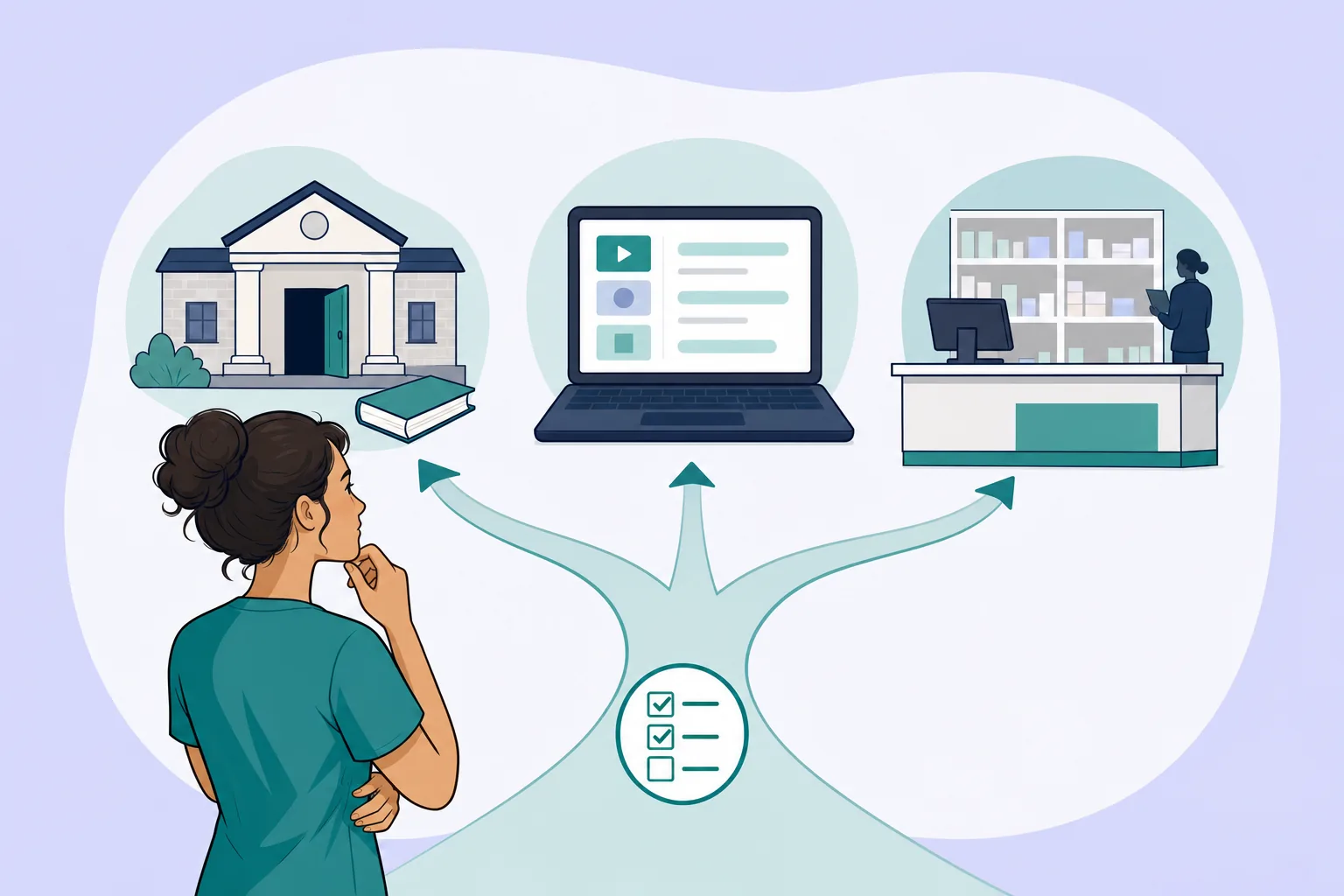
The real choice isn’t simply online versus campus. It’s whether you want an academic award and a set schedule, a focused self-paced course, or learning tied to a pharmacy job. From there, you can match the option to Michigan’s licensing rules and the national exam you intend to take.
Table of Contents
- First, untangle the labels
- Michigan pharmacy technician programs at a glance
- How the Michigan sequence fits together
- School and college pharmacy technician programs
- Independent online PTCB-recognized education
- Employer-based learning in Michigan
- Which path fits your situation?
- Ten questions to ask before enrolling
- Practical next steps
- Frequently asked questions
First, untangle the labels
Words such as certificate, certification, and license sound interchangeable on provider pages. They aren’t. Here is the short version:
- A school, course company, or employer controls its own curriculum and gives you a completion record. A school might call that record a certificate, diploma, or degree, but it is not CPhT.
- PTCB-recognized education means the Pharmacy Technician Certification Board accepts the exact offering for its education option. It also administers the Pharmacy Technician Certification Exam (PTCE) and awards its Certified Pharmacy Technician designation (CPhT) after its conditions are met.
The two national organizations set their own eligibility rules.
- The National Healthcareer Association (NHA) runs a different exam, the Exam for the Certification of Pharmacy Technicians (ExCPT), and separately awards its own CPhT designation after its conditions are met. The PTCE and ExCPT are exams; the designation comes afterward.
- The Michigan Department of Licensing and Regulatory Affairs (LARA), working under the Michigan Board of Pharmacy, issues the Michigan pharmacy technician license. That license is the state’s permission to work in the licensed role; a school, employer, PTCB, or NHA cannot issue it.
- An employer decides whom to hire and how its workplace instruction is organized. Michigan approval applies only to a specific supported offering or location, not to routine onboarding at every pharmacy.
- Accreditation is another separate status. It comes from the accrediting organization named by the school; PTCB recognition and Michigan approval are not academic accreditation.
Michigan also controls two limited situations that beginners may see mentioned. The state’s licensing guide describes a nonrenewable one-year temporary license for an otherwise-qualified applicant preparing for an accepted exam. Michigan’s pharmacy technician rules describe a conditional enrolled-student exemption while a person is in a Board-approved program, with a two-year completion limit. Neither one is a full license or national certification.
In plain terms, you choose a way to prepare, meet the chosen exam organization’s eligibility rules, earn national certification if you use that option, and complete Michigan’s separate license steps. If you expect to perform technician duties while learning, first determine which Michigan status applies to you. For license status and forms, LARA is the official state agency and gives the final local answer; our Michigan pharmacy technician license guide walks through the details in everyday language.
Michigan pharmacy technician programs at a glance
| Path | What you receive first | Cost and hands-on experience | Who it tends to fit—and what follows |
|---|---|---|---|
| School or college | The school’s certificate, diploma, degree, credit, or completion record | A three-school U.S. sample ran from about $2,100 to $22,400. Labs or arranged experience may be included, but you need a written total and scope from the school. | Learners who want a schedule, instructor access, an academic outcome, or provider-arranged experience. Next, complete the appropriate exam and Michigan license steps. |
| Independent online PTCB-recognized education | A course-completion record | Usually covers lessons, study tools, and support. The exam, Michigan license, and workplace experience may cost extra or require separate arrangements. | Self-directed learners who value flexibility and plan to use PTCB’s education option. Next, meet PTCB’s remaining conditions, pass the PTCE, and handle Michigan licensure. |
| Michigan-approved workplace learning | Entry into the employer’s learning plan and, if completed, its workplace record | Terms depend on the employer. Ask for written details on hiring, pay, study time, and exam support. | Learners with access to a specific listed pharmacy or health-system offering. Next, follow the accepted-exam and Michigan license sequence given for that arrangement. |
Bottom line: decide what you want the education itself to provide. If you need college credit, a campus lab, or an arranged externship, look closely at schools. If you mainly need flexible education for PTCB eligibility, an independent course may be enough. If a pharmacy is ready to hire and teach you through a listed arrangement, workplace learning may be the most direct fit.
How the Michigan sequence fits together
Michigan does not require every applicant to attend one particular kind of school. Its current pharmacy technician licensing guide describes a full-license-by-examination option built around an accepted certification exam and the state’s other application conditions. The guide identifies the PTCB and NHA certification exams and allows another national or employer-based exam approved by the Board.
For most beginners, the order looks like this:
- Decide whether you need a full Michigan license, qualify for the temporary license, or meet the enrolled-student exemption before performing technician work.
- Choose the accepted exam you plan to use, then select education or workplace learning that supports that exam’s eligibility rules.
- Complete the certifier’s conditions, take the exam, and receive the applicable national credential.
- Finish Michigan’s separate application requirements for the full pharmacy technician license.
Use Michigan’s approved education and examinations list when your plan depends on a student exemption, a workplace offering, or another accepted exam. Match the exact name and location rather than assuming a similar-sounding option qualifies.
The national eligibility rules also differ. PTCB currently accepts either PTCB-recognized education or 500 hours of equivalent pharmacy technician work experience. NHA’s eligibility material describes a qualifying training-program option or 1,200 hours of supervised pharmacy-related work. Pick the exam first so you don’t pay for education that leads toward the wrong eligibility option.
School and college pharmacy technician programs
School-based education makes the most sense when structure is part of what you’re buying. Depending on the offering, that might mean scheduled classes, direct instructor access, college credit, a lab, an externship, career services, or financial-aid access. No single option includes all of those features, so look beyond the word certificate.
The first result is the school’s award or completion record. It does not by itself make you a CPhT or give you a Michigan license. If a school says an offering is PTCB-recognized, locate the exact title in PTCB’s directory. If it advertises accreditation, identify the accreditor and find the same offering in that organization’s directory. For ASHP/ACPE claims, use the ASHP/ACPE directory.
What should you budget for school?
The span is wide because the sample included a lower-cost technical option, a midpriced community-college diploma, and a higher-cost private-school diploma.
The sample is not Michigan tuition data, and those choices are not three versions of the same product. The offerings differed in award, length, delivery, books, fees, facilities, and practical experience. Use the range to understand the possible size of the purchase—not to decide what a Michigan school should cost.
Ask each school for one written estimate that includes:
- tuition and mandatory school fees;
- books, software, supplies, uniforms, and equipment;
- laboratory, internship, externship, or clinical costs;
- background checks, drug screens, health records, and onboarding;
- national exam and retake charges;
- Michigan application costs;
- travel, parking, and unpaid experiential time; and
- deposits, refund deadlines, and nonrefundable charges.
A higher total can be reasonable when it includes credit, facilities, advising, and arranged experience you actually want. A lower price can also be sensible when you already have access to workplace learning. The useful comparison is the complete package, not the headline number.
Independent online PTCB-recognized education
An independent online course can fit a learner who wants focused lessons without a campus schedule. It is generally narrower than a school-based option: the purchase covers the stated curriculum and support, not an academic award, college credit, a campus lab, or an arranged externship.
Completing a recognized course can satisfy the education portion of PTCB eligibility. It does not finish the whole journey. You still need to meet PTCB’s other conditions, take and pass the PTCE, receive the PTCB CPhT credential, and complete Michigan’s license requirements.
Pharmacy Tech Scholar℠ publishes this article and offers the course described here. Its 120-Hours to CPhT course appeared in PTCB’s directory as an online or distance-learning CPhT education offering when reviewed August 23, 2026. On that date, the course page listed Core at $249 and the Scholar Bundle at $399.
Those prices apply only to the features listed in the selected package. They do not include an academic award, accreditation, a campus lab, an arranged externship, Michigan Board approval, an exam result, national certification, a Michigan license, or employment. That is why a few-hundred-dollar online course and a multi-thousand-dollar college package should not be treated as equivalent purchases.
If online learning appeals to you, look at the access period, instructor help, practice tools, refund terms, exact PTCB directory title, and the costs that remain. You will also need a plan for practical experience if you want it before applying for work.
Employer-based learning in Michigan
Learning through a pharmacy or health system can be appealing because the instruction happens in a real workplace. It may also involve paid work and direct supervision. The catch is access: the employer decides whom to hire or admit, and ordinary new-hire instruction is not automatically a Michigan-approved offering.
Find the exact organization and location in Michigan’s approved list, then ask the hiring contact to explain the arrangement. You should know:
- whether you must be hired before the instruction begins;
- which Michigan license status applies while you learn or work;
- how supervision and progress are documented;
- which accepted exam the instruction supports; and
- whether study time, exam charges, retakes, or continued-employment deadlines are part of the offer.
If you plan to rely on PTCB’s 500-hour work-experience option, remember that PTCB—not the employer or Michigan—decides whether your documented hours meet its eligibility rules. Michigan separately decides whether you have met the conditions for its license.
Which path fits your situation?
- You want college credit or an academic award. Start with school or college offerings and compare credit, transferability, schedule, and total price.
- You want hands-on experience before your first job search. Favor an option that explicitly includes a lab, externship, or placement. Ask whether the placement is arranged, competitive, or your responsibility.
- You need a flexible study schedule. Independent online education may fit, especially if you already know how you will gain practical experience and complete the PTCE and Michigan steps.
- A pharmacy has offered to train you. Make sure the exact workplace offering and location appear in Michigan’s current material, then get the hiring, exam, and license timeline in writing.
- Your budget is the deciding factor. Put every option on the same page: education, award or credit, books, support, practical experience, exam charges, state costs, travel, and unpaid time.
- You haven’t chosen between PTCB and NHA. Read Michigan’s accepted-exam information and the two certifiers’ eligibility pages before choosing your education.
There is no universal winner. A school can be worth more when you need its academic and practical pieces. A focused online course can be the better buy when you mainly need flexible PTCB-recognized education. Workplace learning can be an excellent opportunity when the employer arrangement is real, supported, and available to you.
Ten questions to ask before enrolling
Use this enrollment checklist to get the important answers in writing:
- What will I receive when I finish: a school award, a course-completion record, or a workplace record?
- Who grants each status being advertised—the school, Michigan, PTCB, NHA, or an accrediting organization?
- Does the exact offering and location appear in the directory that matters to my plan?
- Which accepted exam does the curriculum prepare me for, and what else will I need to become eligible?
- What is the complete price after fees, materials, screenings, travel, exam charges, and Michigan costs?
- How will I get practical experience: a lab, externship, clinical placement, or paid work?
- What is the schedule, weekly workload, access period, and cost of an extension?
- What instructor help, tutoring, practice material, and technical support are included?
- What are the cancellation, withdrawal, and refund terms?
- After completion, what remains for the exam, national certification, Michigan license, experience, and job search?
If a sales page uses certificate, certification, accreditation, state approval, and license as though they mean the same thing, slow down and ask for a clearer explanation.
Practical next steps
- Read Michigan’s pharmacy licensing hub and licensing guide to identify the state status that applies before you begin technician duties.
- Use Michigan’s approved-program and accepted-exam document if your plan depends on the student exemption, workplace learning, or another listed option.
- Read the credential page for the exam you intend to take: PTCB CPhT or NHA CPhT.
- Ask the school, course company, or employer for the exact completion outcome, all-in price, practical-experience details, and refund terms.
- Compare the written answers side by side, then choose the option that supplies the pieces you actually need.
For more detail, use our license-versus-certification guide or the broader guide to becoming a pharmacy technician. If self-paced PTCB-recognized education fits your plan, you can also review the disclosed Pharmacy Tech Scholar℠ course and compare its exact scope with the school and workplace choices above.
Frequently asked questions
Does Michigan require pharmacy technician school?
No single kind of school is required for every applicant. Michigan’s full-license-by-examination guidance centers on an accepted certification exam and the state’s other application conditions. Education still matters because it can prepare you for an exam, provide practical experience, meet a certifier’s eligibility option, or support the student exemption when the exact offering qualifies.
How much do pharmacy technician programs in Michigan cost?
As a rough reference, a three-school U.S. sample reviewed in July 2026 ranged from about $2,100 to $22,400 in published totals. It is not a Michigan average, and a Michigan option may cost less or more. Ask for an all-in figure because books, fees, labs, externships, exams, state costs, and travel are not included consistently.
Can I work while I am learning in Michigan?
Possibly, but do not assume that course enrollment or a job offer is enough. Michigan rules describe a conditional enrolled-student exemption for Board-approved education, and the licensing guide describes a nonrenewable one-year temporary license for an otherwise-qualified applicant preparing for an accepted exam. Use LARA’s current material to determine which status applies before performing technician duties.
Is PTCB recognition the same as Michigan approval or accreditation?
No. PTCB recognition applies to PTCB’s education eligibility option. Michigan approval is a state designation for an exact offering or location. Accreditation comes from a named accrediting organization. One offering can hold more than one of these statuses, but none should be assumed from another.
Does an online course make me a CPhT or license me in Michigan?
No. The course provider gives you a completion record. PTCB or NHA awards national CPhT certification after its own conditions and exam are completed. Michigan LARA separately issues the state pharmacy technician license.
Can a pharmacy train me instead of a school?
Potentially. Michigan recognizes specific employer-based offerings and examinations, but everyday workplace onboarding is not automatically included. Match the exact pharmacy and location to Michigan’s document, then get the hiring conditions, completion outcome, exam plan, and license timing in writing.
Sources Used
- Michigan Pharmacy Licensing, reviewed August 23, 2026.
- Michigan Pharmacy Technician Licensing Guide, revised January 2026 and reviewed August 23, 2026.
- Michigan Pharmacy Technician General Rules, reviewed August 23, 2026.
- Michigan Board-approved education and examinations, reviewed August 23, 2026.
- PTCB Certified Pharmacy Technician eligibility, reviewed August 23, 2026.
- PTCB Recognized-Education Directory, reviewed August 23, 2026.
- Published tuition and cost information from three U.S. pharmacy technician schools, reviewed July 13, 2026.