
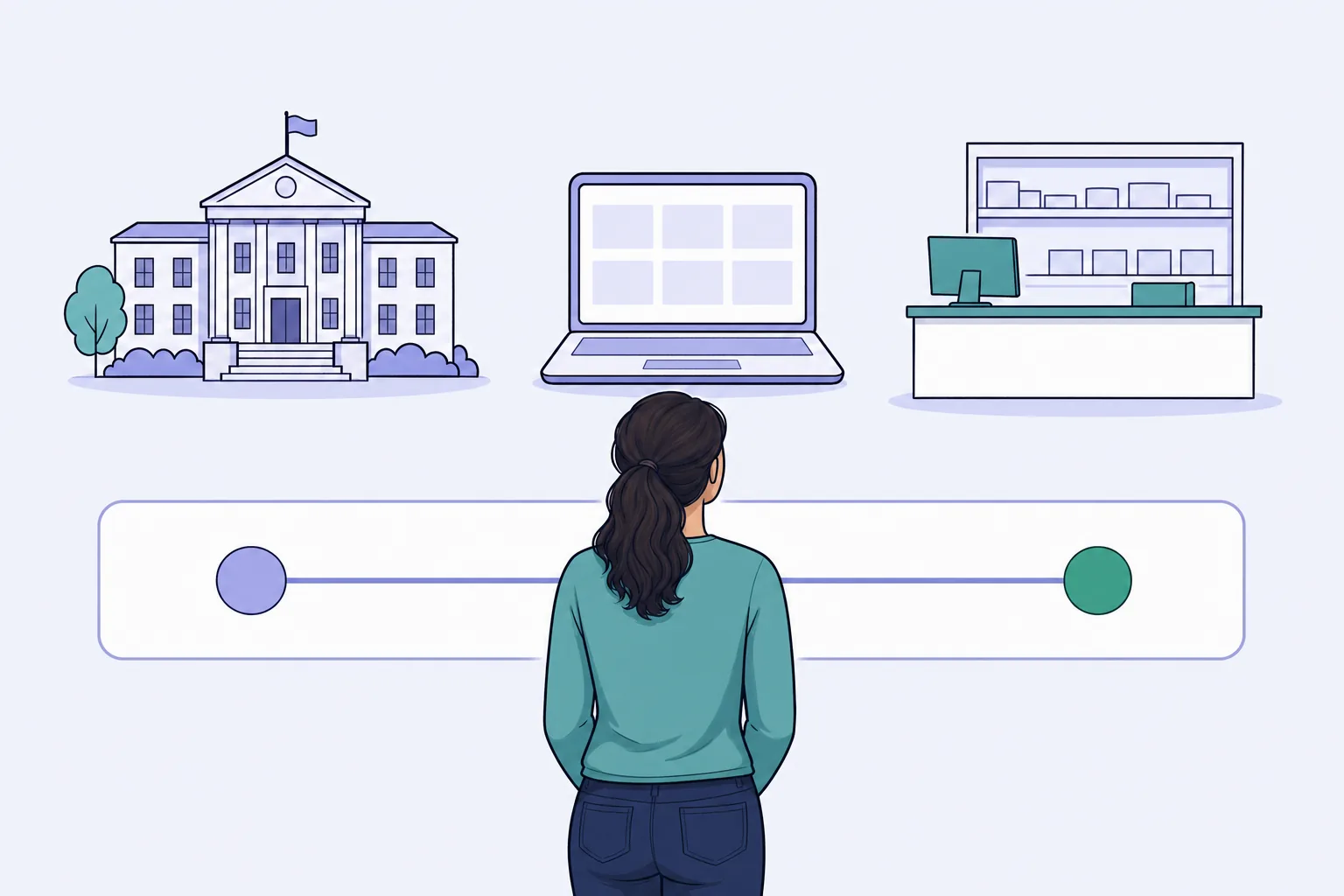
North Carolina pharmacy technician programs range from community college diplomas and associate degrees to shorter classes and independent online courses. Some pharmacies also hire beginners and teach them on the job. The main difference is what you get: an academic award, focused exam preparation or workplace instruction.
A college or course provider teaches the material and issues any completion award. The Pharmacy Technician Certification Board (PTCB) recognizes courses that meet its education requirement. It runs the Pharmacy Technician Certification Exam (PTCE) and grants Certified Pharmacy Technician (CPhT) status to candidates who meet its requirements and pass.
State registration is a separate step handled by the North Carolina Board of Pharmacy. A pharmacy’s supervising pharmacist manager decides who to hire and is responsible for training noncertified employees. Buying a course doesn’t complete those steps for you.
Table of Contents
- Do You Have to Go to College First?
- Compare What Each Option Gives You
- College Study: Look at the Whole Program and the Whole Bill
- An Independent Online Course May Fit Your Schedule
- Learning on the Job Depends on Finding the Right Pharmacy
- Which Option Fits You?
- Questions to Ask Before Choosing a Course
Do You Have to Go to College First?
No. North Carolina allows a pharmacy’s supervising pharmacist manager to hire someone who isn’t nationally certified and provide the required workplace instruction. You need a high school diploma or equivalent, or to be enrolled in a program leading to one.
Your registration steps depend on how you enter the job:
- If you aren’t nationally certified: The manager must report your employment within 21 days and complete your training within 180 days. The law sets a registration deadline of 30 days after training ends; the Board recommends registering within 21 days of starting work. Make the early registration arrangements with your manager when you’re hired.
- If you’re already nationally certified: You must be registered in North Carolina when hired, and you must report the new job within 10 days. You can apply for registration before finding a job.
Those timelines come from North Carolina’s pharmacy technician statute and the Board’s technician guidance. An outside course doesn’t remove the manager’s responsibility for a noncertified employee’s instruction.
North Carolina also accepts CPhT certification from the National Healthcareer Association (NHA), which administers the ExCPT exam. The independent-course discussion here follows PTCB’s pathway.
Our North Carolina pharmacy technician requirements guide covers the fuller application and ongoing registration steps.
Compare What Each Option Gives You
The table below compares what you receive, how you’ll study and what you’ll need to arrange yourself.
| What to compare | College study | Independent online course | Learning through a pharmacy |
|---|---|---|---|
| What you receive first | The college’s diploma, degree or completion award, depending on the offering | Course completion | A job and workplace instruction, if hired |
| How you study | A term schedule; classes may be on campus, online or hybrid | Self-paced study within the access period | The pharmacy’s work schedule and teaching plan |
| Practical experience | Labs or clinical placements when included | Arrange practical learning separately | Supervised work in the hiring pharmacy |
| What the price covers | Tuition plus the offering’s books, fees and other expenses | Course access and stated resources; exam and registration can be extra | Ask about study materials, exam support and any repayment terms |
| State registration | A separate step | A separate step | Manager handles required reporting and instruction; you still need registration |
| PTCB eligibility | A recognized course can satisfy its education pathway | A recognized course can satisfy its education pathway | Qualifying work may satisfy its experience pathway |
| Main commitment | Scheduled study and any campus or clinical attendance | Regular independent study and a separate plan for practical experience | Finding a pharmacy that will hire and teach you |
“Online” alone doesn’t tell you what you’re buying. A college class may include an academic award or clinical placement; an independent course may focus on the material you need to study for the exam.
College Study: Look at the Whole Program and the Whole Bill
A college can be a good fit if you want scheduled teaching, an academic award or practical learning arranged through the school. Some options include campus labs and clinical placements. Others are short-term, noncredit classes. Ask which kind you’re considering, because the time commitment, award and cost can be quite different.
The North Carolina Community College System’s pharmacy technology lookup is a useful place to start. Once you’ve found a nearby option, ask an adviser for the current course sequence, class schedule and details of any clinical placement. Find out who arranges the site and what travel, screening or health expenses you’ll need to cover.
If an offering is described as accredited, ask which institution or program the accreditation covers and which organization grants it. PTCB recognition by itself doesn’t establish accreditation. Our guide to accreditation explains the difference.
What a Full College Degree Can Cost
For a college degree, plan around the cost of completing the program. A short course’s registration fee won’t tell you that amount.
In a November 3, 2026 review of three North Carolina pharmacy technology associate-degree options, their published tuition and itemized expense estimates gave these full-program figures for in-state students:
| Cost measure | Range in the three-program sample |
|---|---|
| Tuition alone | $5,092–$5,244 |
| Tuition plus the listed books, fees and other educational expenses | $7,076–$9,290 |
Tuition is already included in the larger figure. The second range gives you a fuller starting budget, although each college includes different items. Some health and clinical expenses are variable or aren’t listed. Housing, meals and commuting also need their own budget.
These figures are before financial aid and cover the degree, rather than one semester or one year. They are a dated sample, not a statewide average or a guaranteed final bill. A diploma or short-term noncredit class will have its own cost estimate.
Ask for an itemized total for the exact option you’re considering, including general education courses. If you already have credits that the college accepts, request an estimate based on the classes you still need. Then ask what grants or scholarships you may qualify for.
An Independent Online Course May Fit Your Schedule
An independent course can work well if you want organized study material and need to study around a job or family responsibilities. You’ll need to make time for the work yourself and plan separately for practical experience.
If you’re using PTCB’s education pathway, look up the exact course in PTCB’s recognized education and training directory. Online options may be listed under Online/Distance Learning rather than under North Carolina.
Pharmacy Tech ScholarSM publishes this article and sells the course discussed here. On November 3, 2026, the directory listed “120-Hours to CPhT by Pharmacy Tech ScholarSM” under CPhT and Online/Distance Learning. The name describes the course’s goal; completing it doesn’t award CPhT status.
The core course costs $247 for six months of access, with 90 learning modules, six e-textbooks and learner support. It doesn’t award a college degree, diploma or academic credit, and it doesn’t provide a campus lab, externship or job placement. Those differences matter when you’re comparing it with a college option that includes practical teaching or an academic award.
For the core-course option, $247 for the course + $129 for the PTCB application and exam + $30 for the initial North Carolina application = $406 in those three charges. The core course doesn’t include an exam voucher; the publisher’s bundle is a separate offer. You can compare them on the pricing page.
Your own costs may be higher. Allow for any computer, internet, exam travel or retake expenses you would need. PTCB also has residency, disclosure and policy requirements, and you must pass its exam. See PTCB’s CPhT requirements and fee and the state application instructions for those separate steps.
Before buying a course, read its access and refund terms and decide how you’ll get practical experience alongside the study material.
Learning on the Job Depends on Finding the Right Pharmacy
If a pharmacy is willing to hire beginners, ask how it teaches new technicians before deciding whether to buy an outside course. You may want additional exam preparation later, but first understand what the pharmacy will provide.
For a noncertified hire, the supervising pharmacist manager must provide instruction in terminology, calculations, dispensing and labeling, pharmacy law, records, and medication handling and storage. The 180-day completion limit is set by the state statute.
A useful conversation with a prospective manager might start with three questions:
- Who will teach me, and how will we review my progress?
- How will we handle the early registration and employment-reporting steps?
- Are study materials or exam fees covered, and would I have to repay any costs if I leave?
A pharmacy may set its own certification expectations for a job. Ask about those at hiring, along with the teaching plan, schedule and pay. An employer-based option depends on an actual offer; you can’t assume a training position will be available.
PTCB’s work-experience pathway requires at least 500 completed hours of equivalent pharmacy technician work when you apply. PTCB determines what qualifies, so don’t automatically count classroom time or a school placement toward that total. Its work-experience guidance explains the basis.
Which Option Fits You?
If you want an academic award or school-arranged practical experience, start with college options. Compare the actual course sequence and placement arrangements, then budget for the full diploma or degree.
If you want flexible study before applying for jobs, consider recognized independent education. Compare the access period, teaching resources and support, and make a separate plan for practical learning.
If you have a pharmacy willing to hire and teach you, talk through its onboarding plan first. An extra course is useful when it fills a specific need, such as help understanding the material or preparing for the exam.
You can combine these approaches. What matters is knowing what each purchase or commitment adds to your preparation.
Questions to Ask Before Choosing a Course
Use these questions when you speak with a college or compare an online offer:
- What will I receive? Ask for the exact completion award and whether the coursework earns college credit.
- What will it cost to finish? Include all required classes, books, fees, supplies, clinical expenses and separate exam or state application charges.
- Can I manage the schedule? Include class attendance, weekly study time, clinical hours and any deadline for online access.
- What practical learning is included? Find out who arranges a lab or placement and what happens if a site isn’t available.
- Does it support the next step I want? Match the exact course to PTCB’s directory if you’re using its education pathway. Ask how a placement or job relates to state registration.
- What are the admission, funding and refund terms? Get the answers in writing before you commit.
For current registration instructions, the state board’s technician page is the official source. For the education choice, keep the written cost and course details together so you can compare what each option will actually give you.
Sources for This Article
Entry requirements come from North Carolina law and the Board of Pharmacy. National exam and education details come from PTCB and NHA. The college cost comparison uses three associate-degree cost estimates reviewed November 3, 2026; the tuition and broader educational-expense figures are shown separately. Course prices were reviewed on the same date.
Last reviewed: November 3, 2026.